
Nukkad to Nation / Manager mode
Manager mode guide
In manager mode you are the head coach of a city club. You pick the team, sign players, train them and answer to the board. Meet the board’s target and your reputation grows until state sides, franchises and national teams want you.
- Read the board’s target before you choose a club. Big clubs must win the league; underdogs only need to stay off the bottom.
- Use your pre-season signings on the gaps in your XI, not on the best player available.
- Keep your standing with the board above the line. Results count most, then the dressing room and the fans.
- Beat the target and other teams come to you with offers. Climbing the reputation ladder unlocks bigger jobs.
Which club should I choose?
Choose an underdog if you want the fastest rise, a big club if you want resources, and a mid-table side for a balanced start. Every club belongs to one of three tiers, and the tier sets the squad, the money and what the board expects.
| Tier | Squad and money | Board’s target | Reputation for meeting it |
|---|---|---|---|
| Big club | The strongest squad and about 40% more money | Win the league | Lowest |
| Mid-table | A solid squad and a fair budget | Finish in the top half | Standard |
| Underdog | A thin squad and about 25% less money | Stay off the bottom | Highest |
What does the board expect?
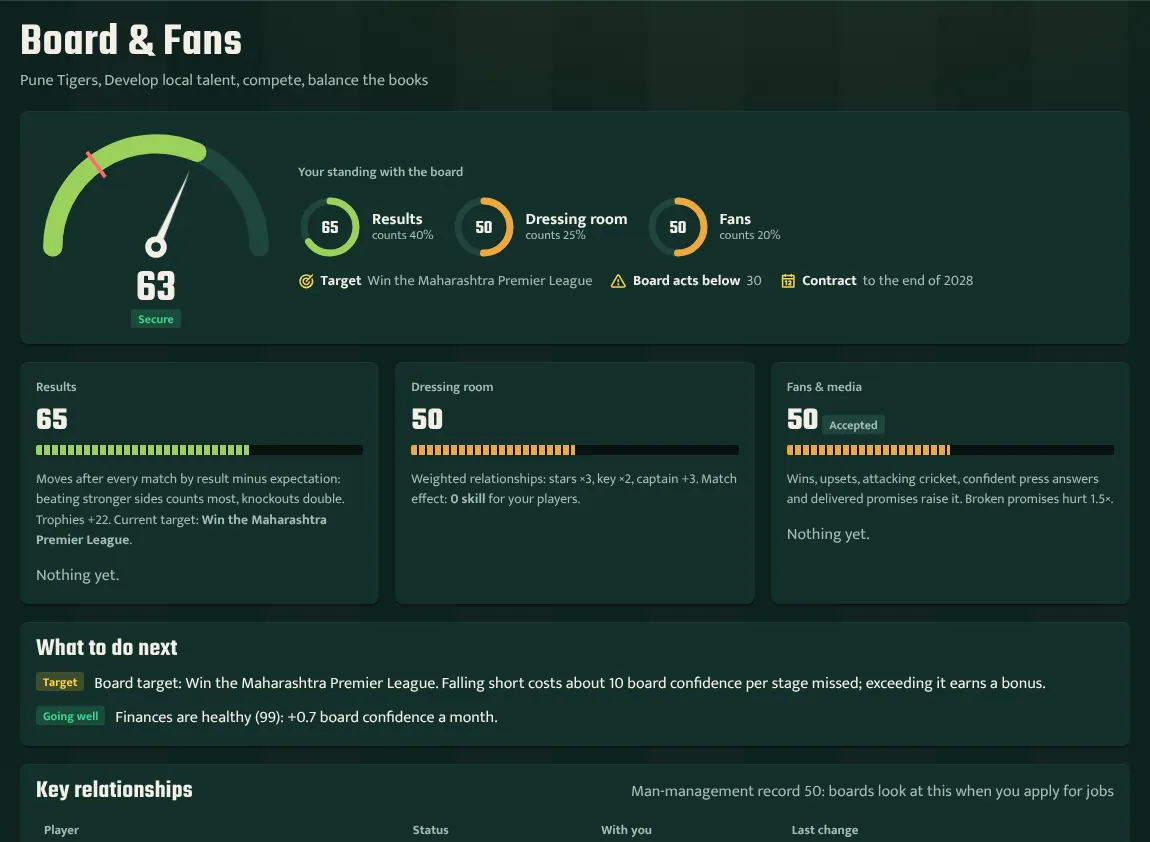
The board sets one target for the season, shown before you take the job and on the Board and Fans page. Your standing with the board is a number out of 100. Results count for 40% of it, the dressing room for 25%, the fans for 20% and the finances for 15%. If it drops below 30, the board acts and you can be sacked.
Meeting the target raises your reputation. Beating it raises it more and brings approaches from bigger teams. Falling short of it costs board confidence for each stage you miss.
How do pre-season signings work?
Before each season a signings window opens, with up to three signings (two if you have just taken a new job). Your scouts prepare a shortlist of free agents and players at rival clubs, filtered by style: power hitters, anchors, pace, spin, all-rounders, keepers and prospects.
- Free agents cost no transfer fee. Players at rival clubs need a fee and are harder to prise away, especially their stars.
- Offering a higher wage or a longer contract improves your chance. Every offer has to fit your wage budget.
- Sign for a gap in your XI. A spinner for a turning home pitch or a finisher for the last overs often wins more matches than a bigger name.
How do I pick the team?
The Squad page shows your players beside a team sheet laid out on a pitch, in top, middle and lower order. Tap a player in the XI to swap him, move him up or down the order or drop him to the bench. Choose your captain and wicketkeeper below it. You can pick a different XI for each format, or let the game pick automatically for every match.
Which tactics should I use?
Set a batting approach (Cautious, Balanced, Aggressive or All-out), a bowling plan (Contain, Balanced or Attack) and how hard your batters run (Safe, Normal or Aggressive) before the match, then change them live. The bowling plan also sets the field you see on the ground. Balanced suits most matches. Go aggressive when chasing a big target or in the last overs, and contain when you are defending a small total with a weaker attack. The field on the ground changes with your plan.
How does training work?
The team programme sets a focus (general, batting, pace bowling, spin bowling, fielding or fitness) and an intensity (light, normal or intense). Focused skills develop 45% faster and the rest 15% slower, so change the focus to fit the next competition.
Personal coaching puts a specialist with one player every day, and young players improve fastest. Specialist camps give a short, expensive boost. The development board ranks your players aged 25 and under by how much room they have to grow.
Is a youth academy worth it?
Yes, if you plan to stay a few seasons. An academy brings two to four teenagers with real potential in every intake. You grow them, give them games and build a side the board loves and rivals cannot afford.
| Level | Prospects per intake | Potential | Development |
|---|---|---|---|
| Nets and coaching | 2 | About 60 to 80 | 25% faster |
| Residential academy | 3 | About 64 to 85 | 45% faster |
| Centre of excellence | 4 | About 68 to 90 | 70% faster |
Higher levels also give more accurate scout reports. Each level costs money to build and a little every month to run.
How do finances work?
Income comes from membership fees, sponsorship and gate receipts, which rise when the fans are happy and in knockouts. The main costs are wages and running the ground. Going over the wage budget or into debt costs board confidence every month. Contracts end on 1 January, so renew the players you want to keep before then.
How do I get a bigger job?
Your reputation decides which teams will consider you. It grows when you meet or beat targets, win trophies and earn coaching badges, and falls after poor seasons or a sacking.
| Reputation | Name in the game | Who will talk to you |
|---|---|---|
| 0 | Local name | Bigger clubs in your state |
| 18 | State name | Clubs anywhere in the country and your own state side |
| 30 | National name | State sides across the country and the home franchise league |
| 45 | Big name abroad | Franchises and state sides around the world, associate national teams |
| 60 | Global name | Full-member national teams |
Apply for vacancies on the Jobs page and answer the interview panel, or wait for approaches: beat a target and teams come to you. Coaching badges, from Level 1 Coach to High Performance Coach, take a few weeks of study each and add reputation and better training.
Common questions
Can I get sacked?
Yes. If your standing with the board falls below 30, the board can sack you. Your reputation takes a hit, but you can apply for other jobs straight away or wait for offers from teams that still rate you.
How quickly can I reach a national team?
A national job needs a reputation of 60 for full members and around 45 for associates. Managers who beat their targets every season usually get there in four to six seasons.
Do I have to watch every match?
No. Watch the matches that matter live and take a quick result for the rest. Your tactics apply either way.
What happens at a franchise auction?
You first choose which players to retain, then bid lot by lot in the auction room against the other franchises, within your purse.
Next: read the tips to win more matches or the full manual.